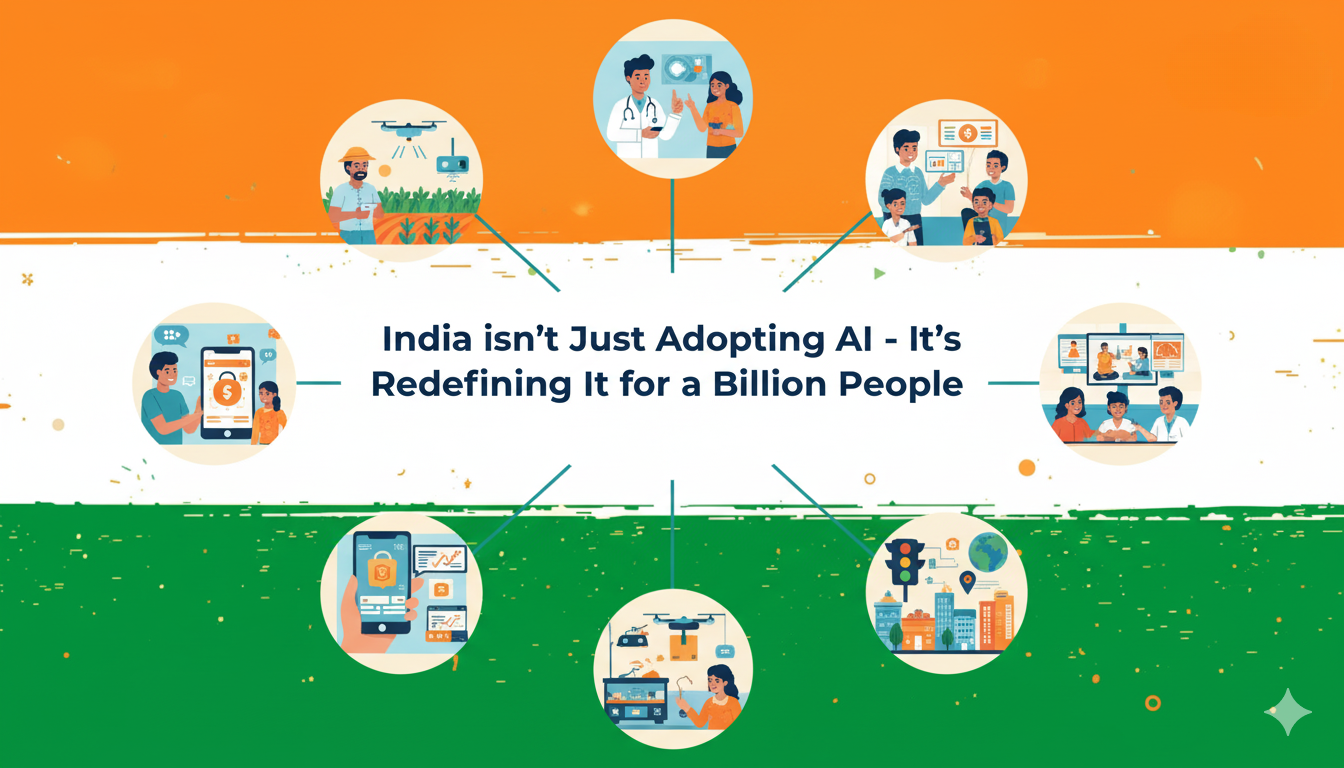
For years, the global AI story has orbited trillion parameter models and a sprint toward AGI. India is writing a different chapter: one where AI behaves like public infrastructure built for voice and vernacular, optimized for low bandwidth, and measured by inclusive outcomes. This isn’t a rejection of frontier research. It’s a deliberate strategy to apply proven AI to foundational problems at unparalleled scale.
Below are five takeaways that matter to Indian enterprises right now and how Fristine Infotech (and our sister firm DSV Consulting) translate these shifts into practical, measurable value for your business.
1) “AI for All” isn’t a slogan, it’s the operating system
India’s national approach anchors AI to social goods: access, affordability, and last mile delivery. That ethos shows up in where resources go public compute capacity, India-centric foundational models, open datasets, and large-scale skilling and in how programs are evaluated, with success tied to real adoption rather than lab scores.
The inclusion lens is sharpening around the country’s informal workforce. Think voice-first interfaces that cross literacy and language barriers, assisted onboarding for small merchants and gig workers, and transparent, on-time payments supported by digital rails. This is the core of India’s “utility-grade AI”: the expectation that services must work for people on mid-range Android phones, over spotty networks, and in the language they think in.
What it means for enterprises
Products that are multilingual, voice-native, and mobile-light will ride policy tailwinds and find natural distribution. If you design for the edges rural users, feature phones, low data you rarely lose the center.
How we help
Fristine Infotech builds vernacular-ready customer journeys (voice, chat, and text), consent-first data pipelines, and deployment patterns that balance latency with cost. DSV Consulting aligns your roadmap to regulatory and public-infrastructure rails so you benefit from the same momentum powering national programs.
2) India’s “smart follower” advantage: scale beats speed-to-first
India’s playbook is candid: it may not always be the first to invent, but it can be the best at adapting proven technologies to complex, large-scale realities and then exporting those patterns to similar economies. Call it late-mover advantage with early-mover scale.
Enterprise adoption reflects both ambition and friction. Many firms have budgets and pilots; far fewer have robust production workloads with clear cost allocation and ROI attribution. The bottlenecks aren’t enthusiasm or use-case ideas, they’re the unglamorous disciplines of data readiness, observability, model governance, and change management.
What it means for enterprises
Winning isn’t about chasing every new model release. It’s about operational excellence, clean data contracts, reliable evaluation harnesses, secure access, and unit economics you can defend.
How we help
We implement production blueprints: feature stores, prompt and model versioning, evaluation and red-team frameworks, and AI FinOps (showback/chargeback, caching strategies, context-length controls). DSV Consulting complements with operating-model design, roles, rituals, and review cadences, so capability sticks across quarters, not just demos.
3) The killer app is conversation: voice, chat, and the 22-plus language moat
India’s interface advantage is hiding in plain sight: the country’s default UI is increasingly conversational and local-language. Voice search and voice assistance usage is among the world’s highest, customer behavior has already normalized “speak to operate.”
You can see this in payments. Conversational UPI now lets users transact via in-app voice and even on phone calls through IVR, vital for rural and peri-urban households that rely on feature phones. The design target is explicit: make digital payments usable and trustworthy for families on low incomes, with minimal friction and clear confirmations.
You can see it in travel. IRCTC’s AskDISHA began as a chat assistant and matured into a multimodal service that handles high daily query volumes with strong accuracy and self-service completion. Its 2025 upgrade added voice ticketing, refunds, and cancellations, proof that conversational UX can carry complex, regulated flows at national scale.
Underneath this interface layer sits a strengthening language stack. National platforms now expose speech-to-text, text-to-speech, and translation APIs across the full set of scheduled Indian languages, enabling multilingual experiences in public services, banking, retail, and logistics. The result is a growing ecosystem of Indic language models, domain lexicons, and evaluation datasets that make it cheaper and faster to support new languages and dialects.
What it means for enterprises
If your product isn’t voice-first and vernacular-ready, you’re leaving growth on the table. The next 100 million AI users won’t show up through English-only chatbots and heavy apps.
How we help
Fristine Infotech integrates national language APIs, tunes retrieval-augmented generation (RAG) on Indic corpora, and builds low-bandwidth, voice-native journeys that run well on mid-tier devices and IVR. We also stand up per-language evaluation sets and human-review loops so quality scales with coverage.
4) Employees are sprinting ahead, IT must catch up (safely)
India leads the world in employee-led AI adoption. Knowledge workers use AI every day to summarize, draft, analyze, and automate, and many bring their own tools even when their organizations lag. Leaders overwhelmingly agree AI is essential to remain competitive, yet many admit they lack a clear plan to scale it safely.
Overlay that with the production gap and a pattern emerges: individuals are moving fast, institutions are catching up. The result is a mix of innovation and risk, shadow tooling, fragmented spend, unclear data handling, and duplicated experiments.
What it means for enterprises
The question is no longer “Should we use AI?” It’s “How do we standardize safe, measurable AI without suffocating grassroots momentum?” You need sanctioned toolkits, clear guardrails, and observable value.
How we help
We roll out secure BYOAI frameworks (data-loss prevention, safe connectors, policy prompts), catalog and approve high-value use-cases, and instrument ROI from day one, time-saved, error-rate reductions, throughput gains, and revenue impact tied to teams and workflows. DSV Consulting drives change management and skills uplift so adoption is pervasive, not patchy.
5) India’s biggest problems are its best testbeds
Consider the judiciary. The case backlog runs into tens of millions across district courts, High Courts, and the Supreme Court, sobering numbers, but also an unmatched training ground for assistive AI built to handle volume, heterogeneity, and nuance.
The response has been practical and incremental. Translation systems now convert large numbers of judgments into Hindi and regional languages for public access. Real-time transcription supports Constitution Bench matters. Prototype tools integrated with e-filing flag defects for faster corrections. These are assistive deployments, no “robo-judges”, but each step improves throughput, searchability, and transparency. At India’s scale, small wins compound.
The broader lesson is powerful: if AI can survive and improve systems this complex, your organization’s service, claims, legal ops, credit, or field operations are absolutely in range. India’s realities harden AI. Once it works here, it tends to work almost anywhere.
How we help
Fristine Infotech builds case triage, summarization, multilingual search, and verification checklists for high-volume teams, with human-in-the-loop thresholds and audit trails. DSV Consulting maps process redesign so AI augments roles rather than creating new bottlenecks.
What winning looks like in the Indian AI context
1) Design for distribution
Voice + chat + low-bandwidth + regional languages = reach. Conversational rails have already proven they can carry complex tasks like payments, bookings, and refunds. Build once with distribution in mind, then localize.
2) Treat data as a product
The leap from POC to production hinges on clean data contracts, quality baselines, lineage, and access controls. You can’t govern or measure what you can’t observe, especially when prompts, embeddings, and retrieval patterns evolve.
3) Build multilingual evaluation into the pipeline
Support for 22-plus languages is a feature only if quality holds. Create per-language test sets, set acceptance thresholds, and keep human review in the loop where risk is high.
4) Nail AI FinOps early
Model choice, context length, retrieval design, and caching can swing unit economics by an order of magnitude. Instrument cost-to-serve and tie it to value creation, continuously.
5) Align with public rails
As national compute and language services mature, partnering with these rails reduces time-to-value and simplifies compliance. Make “use public where sensible, go private where necessary” your default posture.
A practical path forward
Phase 0: Diagnostic (2–3 weeks)
- Inventory AI-in-use (formal and shadow), and rank top 10 use-cases by value, feasibility, and risk.
- Baseline KPIs: throughput, error rates, time-to-resolution, satisfaction.
- Map compliance and data-protection needs for multilingual, voice, and IVR contexts.
Phase 1: Pilot two thin slices
- Example A: Voice-first support in Hindi plus one regional language, powered by retrieval from your policies/knowledge base; includes call deflection and escalation.
- Example B: Ops copilot for back-office teams: summarization, verification checklists, claim/case triage, and audit logging.
Phase 2: Productionize with guardrails
- Observability (latency, accuracy, hallucination risk), human-review thresholds, versioning, and AI FinOps showback.
- Secure connectors and DLP for sanctioned tools; rollout playbook for teams.
Phase 3: Scale and localize
- Expand languages and channels (WhatsApp, IVR, kiosks), add departments, and certify evaluation datasets and calibration rituals per function.
Fristine Infotech owns the build-run-observe layers (applications, integrations, MLOps, guardrails). DSV Consulting drives operating-model design, governance, skills, and change management, so capability outlasts the initial push.
The bigger picture: Accessibility is India’s unfair advantage
AI is often described as a general-purpose technology. In India, it’s becoming a kinetic enabler of the digital economy, most powerful when it is inclusive and proximate to everyday life. While others chase model supremacy, India is optimizing for distribution supremacy: voice, vernacular, and public rails at national scale.
Enterprises that align with this reality won’t just reach more people, they’ll serve them better—with lower friction, higher trust, and stronger unit economics. That’s the real promise of India’s AI moment: to make intelligence useful where it matters most.
Ready to move from pilots to production, India-style?
Let’s co-design your first two thin-slice wins and put the observability, governance, and cost controls underneath. When the interface is right and the rails are public, AI’s value scales quickly and durably.